-

dbca silent mode – Windows
Just a quick tip that often catches me out. If you are like me, you have long since tired of clicking Next, Next, Next, … through the GUI when you want to quickly create a database. Many people work around this by storing a set of database creation scripts. However, you can do even better.… Read more
-

2019-what grabbed your attention
Here are the blog posts that you hit on most this year, with the most viewed entry on top. Unsurprisingly is it related to my bugbear with the OpenWorld catalog. I mean, every conference organizer must know that the one thing the attendees will always want is to get access to all of the content.… Read more
-

Larger number of Exadata storage indexes
We had a question on AskTOM inquiring about how to handle the issue of only 8 storage indexes being possible on an Exadata engineered system. If you are unfamiliar with what a storage index is, they are part of the suite of features often referred to as the “secret sauce” that can improve query performance… Read more
-

Do you work in I.T?
If you do, then you know that only 20% of your I.T work is spent at the office. And no, I’m not talking about telecommuting or working remotely here. I’m talking about the 80% of our time we spend handling all those I.T calls from friends and family So I was motivated to put together… Read more
-

Cloning a schema with a one line command
Aug 2024 Update: I updated this routine to be a little more robust for those wanting to use this in a more “production-esque” way, ie, have a dedicated user account, plus handle the nuances of cloud versus on-prem etc. If that is what you need, then please use “clone_schema_v2.sql” in my git repo, not the original… Read more
-
DML error logging – customising the error log table
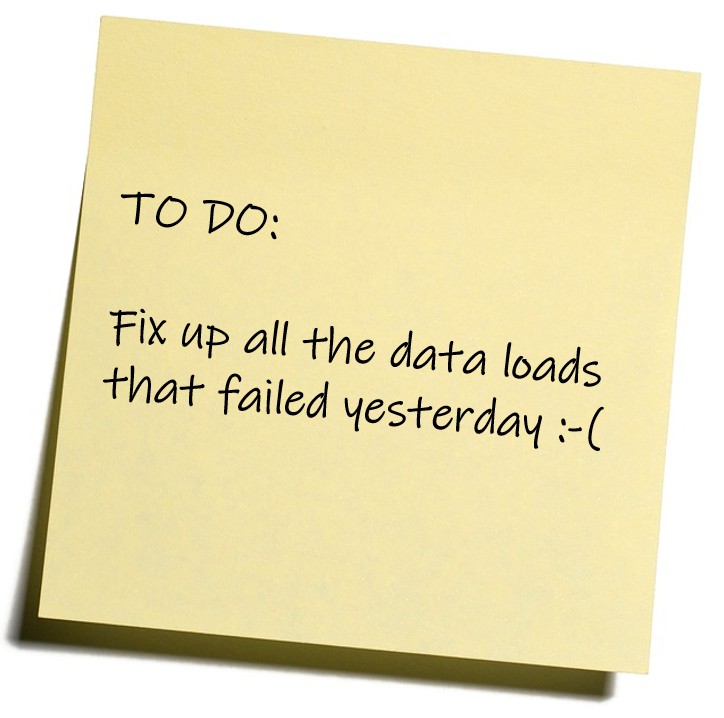
I posted a nice little feature of DML error logging recently, and a comment came in mentioned that caution is needed with DML error logging because the errors are logged persistently. Hence if you ran a load multiple times, or multiple sessions were utilizing the facility, then the error logging table can quickly become a… Read more
-
The holistic SQL tuning series
I did a set of articles for Oracle Magazine on a more holistic view of SQL tuning. What do I mean by “holistic”? It was a reflection of a common problem that I see when questions come into AskTOM, or when people in the community approach me at conferences, namely, there is an inclination to… Read more
-

The definition of proof
One of the pieces of advice that I often see on the ‘net is that undo space is somehow this incredibly precious thing, and as a consequence, one should always keep the amount of uncommitted changes in the database to a small size. Personally I think that is baloney (Ed-in reality, as an Australian I… Read more
-

PIVOT does not work with materialized view refresh
We had an AskTOM question come in recently where our customer was very excited about the PIVOT operator in SQL which lets you transpose rows to columns. This is a very common requirement in applications that want to take data that has been modelled in “pure” relational form, and present in a more “human-digestible” form.… Read more
-

All the OpenWorld 2019 downloads!
Why dig around for hours in the catalog? Here are all of the downloads registered in the OpenWorld catalog! You can pick and choose from the list below, or if you want a CURL script that will download the entire set, you can find that here. Enjoy! BOF1167 Java on Azure BOF,Reza Rahman BOF1321 Why… Read more
-
Then OpenWorld mega-list
You’ve been to OpenWorld… You’ve seen the great content… Networked with the community… But now you want to keep the ball rolling and catch up with the speakers on twitter. So here is the mega-twitter list…all the speakers from OpenWorld and CodeOne that provided their twitter handles at registration. Enjoy! Abhinav Shroff https://twitter.com/abhinavshroff Ahmad Gohar… Read more
-

Extending in-lists past the 1000 item barrier
A well known “limitation” of Oracle is that you can only have 1000 elements within an IN-LIST style expression in your SQL predicates. I use the quotes because I’ve always found that if you are heading into the territory where you need more than 1000 items in an IN-LIST, then it is often indicative of… Read more
-
Subscribe
Subscribed
Already have a WordPress.com account? Log in now.
 Learning is not a spectator sport