-

How to make queries to DBA_FREE_SPACE faster
The other day as my PC popped up its usual “Hey, you really should look at buying a bigger disk” message, I was motivated to see if I could clear down some of the space utilization on the myriad of databases on my machine. On the majority them I encountered no issue doing that, but… Read more
-

How to do a GRANT on an entire schema
TL;DR: There is no schema grant command in Oracle, but this routine lets you get close. Update 2024: You’ll be pleased to know that this shortcoming is now addressed in Oracle Database 23ai! See my post for more details. Why no schema level grant? A very common request on the various forums that exist for… Read more
-

How to upgrade to Oracle 19.8 on Windows
As always, you should follow the instructions in the README.html that comes with the Release Update, but because I know many people like to see what the experience of others is like, here’s my run of the patch application. As always don’t forget to run your CMD prompt as Administrator, otherwise OPatch will typically have… Read more
-
Developer Live wrap up
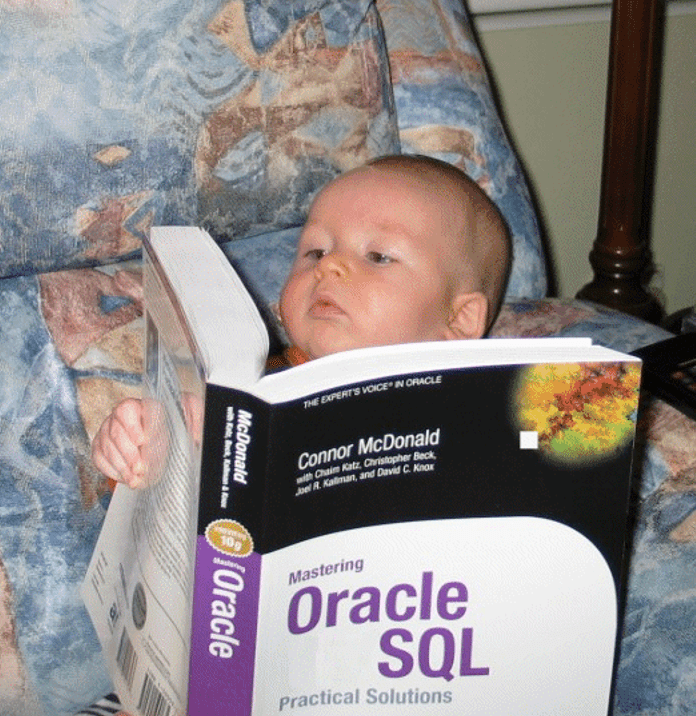
The Developer Live event for database has concluded. Thank you to the (almost) 2000 people that attended my talk across the USA, Europe and APAC timezones! I very much appreciate you giving up your time to attend the session. Whilst we were doing some Q&A I tried to add as many useful links into the… Read more
-

Faster DISTINCT operations in 19c
If I gave you a telephone book and asked you to tell me how many distinct street names are present in the book, then the most likely thing you would do is …Wave your mobile phone at me and ask what a “telephone book” is . But assuming you’re old enough to remember telephone books,… Read more
-

How to stop your site from being Clickjacked!
In the language of the millennials I should start this post with “TIL”, but for the rest of us out there that are “not so down with the cool kids” the expression is “Today I learned”. Anyway…today I learned about a security risk called ClickJacking. You can read the full history and details of it… Read more
-

How to change Scheduler maintenance windows
There are a few possible reasons why you might be one of those people why you might be using your database late in the evening. These include you support a 24 by 7 system and so you often need to be online late at night, you are a hopeless geek and love tinkering with the… Read more
-

Automatically generate audit capture for tables
A weekend audit Often if you see the words “weekend audit” in a non-technical sense, it means that awkward moment where you look at the state of your house/bedroom/bathroom/bookshelf/shed etc and say to yourself “Yup, it is time we had a weekend audit of all this crap” But I had a different kind of weekend… Read more
-

How to TREAT data in a CLOB as JSON
What better way to start a new week than with a cheesy title to my blog post! But there is method to my unstructured madness today as we talk about the TREAT function, available from 18C for JSON data. As many of us will already know it is possible to dive into JSON data and… Read more
-

SQL tuning with Hashing and Sorting
Aggregation SQL is not all just primary key lookups, although some applications sadly see SQL as only useful in that way. As soon as you have data, you will always have the need to aggregate it, and SQL is the perfect vehicle for that. I did a video recently which I will embed below that… Read more
-

DDL gets my goat
First things first. If you are not familiar with the term “gets my goat” then you can find a definition here . But put simply, it means things that you find frustrating or bothersome. What is getting my goat today is the time it takes to get the DDL for a database object using the… Read more
-
Completely free training for Oracle novices
At college/university, the learning path for a computing-related course often includes several coding languages, and occasionally some treatment of database technology as well. But often, it is only once you enter the business world as you embark upon your IT career that you truly start to face the demands of enterprise-level data requirements. The small… Read more
-
Subscribe
Subscribed
Already have a WordPress.com account? Log in now.
 Learning is not a spectator sport