I poke around the internet a little bit, and I often stumble upon content like the following:

Screenshot 2024-09-01 205943

Screenshot 2024-09-01 210137

image

image

image

That kind of stuff absolutely bamboozles me. I’ve been around the IT industry for, well, lets just say “a number of years” 😂 and a consequence of that duration is that I’ve worked with a lot of languages. If I go right back to where it all started, it was learning BASIC from a magazine. The first lesson you learnt quickly was to leave some gaps in between the line numbers in your code, because if you later wanted to add code, you had to pick line numbers that would fit “between” the existing ones. Code ran top to bottom as defined by the line number sequence. That could be frustrating, but if you wanted to get something achieved, you just got on with it. You wrote and debugged your code until it worked, and you had a running program.

File:CommodoreBasic.png

Then in school and university, I learnt Pascal. Not having line numbers was nice, but coming from BASIC with its top to bottom execution, having to define routines before you called them was a shock to the system, and it was the first time I’d used a compiler. Why did I have to compile a program before running it? It all was initially a bit odd but if you wanted to get something achieved, you just got on with it. You wrote and debugged your code until it worked, and you had a running program


File:Pascal Code.jpg

Then came the C language. The concept of trusting modules that someone else had written was a new thing, and its flexibility was a danger to the novice. Want to overwrite some memory that wasn’t yours? Sure, no problem. And coming from the “baby sitter” fashion of previous languages where they tried to protect you from yourself to a language that simply said “Core dump” when something went wrong took some time to adjust to. It felt like this was a language not for the faint-hearted, but if you wanted to get something achieved, you just got on with it. You wrote and debugged your code until it worked, and you had a running program

File:Source code in C.png


Then my first job in the “real world” was as a COBOL programmer. Incredibly verbose, you had to write a lot of text to do simple tasks, and the concept of variables being just overlays on bytes of data from a file seemed very odd, but if you wanted to get something achieved, you just got on with it. You wrote and debugged your code until it worked, and you had a running program
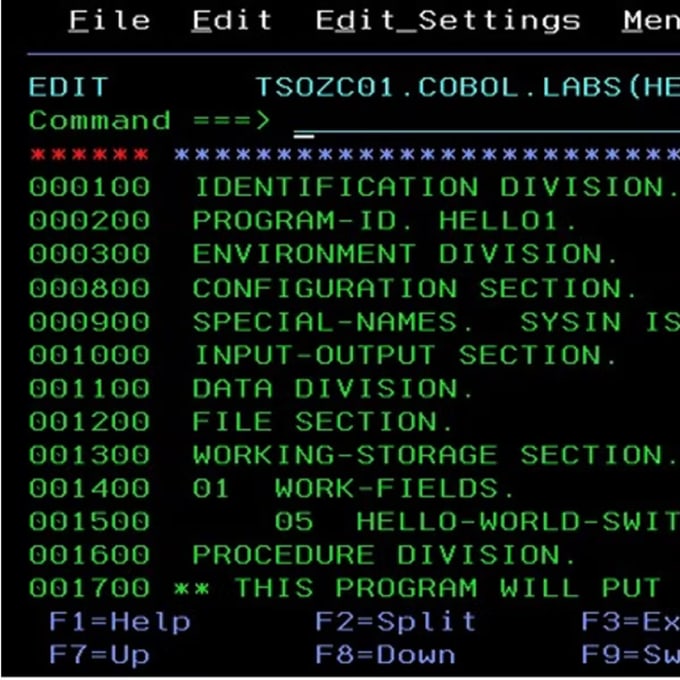
 

Help you with cobol, mainframe, python by Amanpreetdesign | Fiverr


There’s been of other languages as well along the way (Java, C++, ProLog!) but recently I’ve been dabbling with Python, and again – some weird things to learn. I mean, indentation not being just for readability but actually changing the way the code could run? Cmon man, you’re joking, but if you wanted to get something achieved, you just got on with it. You wrote and debugged your code until it worked, and you had a running program

File:Python add5 syntax.svg


With all of the languages I’ve used – with all of their quirks, features, nuances and strange mannerisms, I cannot remember in any case where I thought: “I am so emotionally distressed by the language I am using that I need to tell the world how much I hate it”.

I just can’t work out why anyone would hate a language. You might have a favourite language, you might have some pet peeves about how a language is used, or much more likely, some frustrations with how it is used in a particular work environment. But for the overwhelming majority of your time in the IT workplace, the decision on what languages, what platforms, what technologies that will be used was taken long before you joined the team. Or even if you are part of a team to make a decision on these things, one would hope you would be looking the broader IT industry to see what the norms are, and I can assure you, SQL is most definitely a norm. It just seems to me such a wasted amount of emotional energy to rant about your hate for SQL or any language for that matter. I’m not sure what you’re hoping to achieve to be honest.

Of course if you ask me about Apple products….well, that’s a different story 😂.  (Just jokes)

9 responses to “SQL … I am so confused”

  1. Because they’re in the wrong job.

    Companies are so desperate for staff these days that they hire anyone “off the street”. It’s a highly skilled job requiring computing qualifications, but companies take on anyone willing.

    One guy had a PhD in Micro Biology and thought he was capable of working as an Oracle consultant in a major bank. He had no experience in computing, but his ego was so big he thought he could turn his hand professionally to anything! Needless to say he didn’t last long, but long enough to get his pay & cock a few things up while blaming it other people. Those with PhDs (in other subjects) are the worst. They always come with a massive superiority complex, but an ability as low as Donald Trump’s to run a country properly.

    We’re seeing all kinds of botch jobs in every company due to unqualified staff. We need physical Oracle universities across the globe to train people up properly.

    1. But 70% of Americans vote for Trump.

  2. In my experiece the problem is that everyone who know the instruction SELECT * FROM belivies to be a SQL expert

  3. Probably those who hate SQL will be glad to discover that now they can just write “SELECT AI …” …
    This reminds me of someone at my first job (somebody older, with a good old-style education, though not IT-related)
    who used to say: “Oh … yes, SQL is simple … you just write SELECT … and it works !” …
    Or, many years later, after a first Power Builder introductory lesson, one of the “students” saying: “I don’t like all this object-oriented !” …
    just to become a project and department manager afterwards …

    If an ideal language existed, we probably would not see a new language born every other day, which promises to solve all problems …
    And, not just people, but companies themselves change their optic …
    I remember many years ago when Oracle thought that the future development language/tool would be ADF … with a tone of automatically generated Java code behind it, and the “golden sentence” that puzzled me: “No, you don’t need to know any Java for using it !!! “.
    In those years I think APEX already existed under its first name of HTML-DB …
    And, now, they say the same about APEX … aka “You don’t need to know any HTML, JavaScript, Ajax, JQuery … you name it …
    just very little of SQL and PL/SQL” …

    One thing is for sure: there are indeed many managers in high enough IT positions who really don’t master anything … they just know how
    “to action others” for doing the work, and, then, gather the undeserved awards …
    “To know or not to know ?” … That is the question ! 🙂 …
    There are too many whose “ego”-s seem to be inversely proportional to their knowledge level …

  4. I guess people like the “AI Ambassador” won’t mind if they get 500 rows back instead of 4000 and not all the columns they wanted because the model was hallucinating and forgot that = NULL and IS NULL are two different things. Oh, and they also had to change the question (prompt) 10 times to get to the right table(s) in the database for the answer. Or that the model wouldn’t return any rows with names like “King” because their country doesn’t have a government with a monarchy.

  5. I cut my teeth on assembly and BASIC. Yeah, what a combination.

    Next came a variety of things, in no particular order

    C, Perl, BBx Basic (really a very cool Basic, I would use it again), SQL. PL/SQL, Python,Go, Bash, DataFlex (ugh), m4 (macro language)

    While I like some more that others, I could not say I hate any of them. Though if I never see DataFlex again it will not bother me.

    The thing is, these are all tools. If the tool doesn’t suit you 100%, either find another tool, or learn how to properly use the ones available.

    Personally, I am most adept at Bash, Perl, SQL and PL/SQL. There are reasons for that.

    I have spent many years with mostly ssh access to work environments. While a GUI may be made to work, it is usually just too slow.

    For most database work, I find that GUIs are just too slow anyway.

    My IDE of choice is then vi/vim.

    Some may see the reason for why I am most adept at the 4 languages listed.

    All are available on Oracle database servers, which are usually running a Linux OS in my experience.

    Perl is a bit of a bonus, as it is installed with every on-premises Oracle DB installation, and includes the DBI and DBD::Oracle modules for database connectivity.

    Perl has been extremely useful to me for 30 years in connection with Oracle databases.

    I don’t necessarily love Perl, as it does sometimes make me a bit crazy.

    But, it does make things possible that would simply be too cumbersome in Bash.

    If the job is too complex for a one liner, I use Bash.

    If Bash is too unwieldy then it will probably get written Perl.

    If CPU intensive code is too slow, it may then get re-written in Go or C. Sometimes Go is chosen for cross-compilation to Windows.

    These are all tools. Learn how to use them, or find something else to do.

  6. Wow. In late 1990s, having some experience in FORTRAN, Basic, and Pascal, having done my PhD in Pascal, – I came across SQL. It took me about one year to change from copy-paste to some naive own writings in SQL. Totally another manner of thinking. And it is GREAT!!

  7. I bet those people were never exposed to hierarchical and network databases either. Probably they are not affiliated with 3 and 4 GLs other than COBOL. Anything else is too complex! And what you cannot grasp you start to hate. 🤣

  8. Still got to say Python and whitespace sucks… that is the craziest design decision ever.

Leave a reply to iudithd5bf8e4d8d Cancel reply

This site uses Akismet to reduce spam. Learn how your comment data is processed.

Trending